Demystifying Decarbonization
A decarbonized building refers to a building that has eliminated its carbon dioxide (CO2) emissions resulting from its energy consumption and operational activities, including the embodied carbon of materials used. Electrify Everything is one simple phrase often used, though done right, a decarbonized building is much more than just changing the types of heaters. To really decarbonize a building, it takes using the right kit-of-parts while creating an aligned vision which can resonate and get everyone involved to be all-in. While we want buildings to be simple, they are a huge mess of parts and pieces, especially in terms of the number of parties involved in the process. To truly decarbonize buildings requires getting everyone on the team to be in lock step and thinking of ways to make the process even better. The revolution starts with you and your own power to manifest a vision for the projects you are involved with. While there are many topics, I wanted to share two areas near-and-dear to my heart, high-performance building envelopes and efficient heating, ventilation, and air conditioning systems (HVAC).
Build durable, well-insulated envelopes
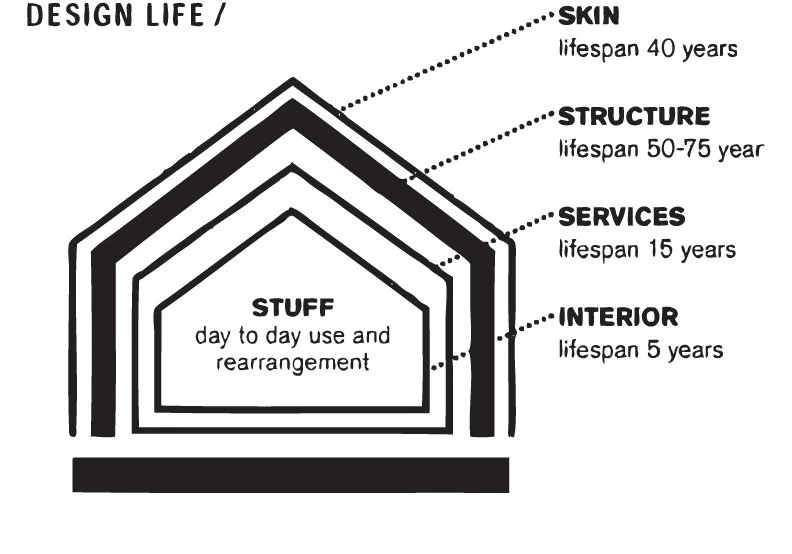
Even if you are not versed in building science, the idea of making a long-lasting envelope that is well insulated is a simple one. The best envelopes focus on durability; thinking about managing moisture and water, ensuring the wall will last 50+ years, and a continuous blanket of insulation, not letting any corners or edges go un-insulated.
Focus on the whole problem of design, construction, and testing, not just product premiums. Often, adding insulation or creating a more elaborate façade screams $$$, referencing every choice from a cost add. Remember, high-performance facades have been built at cost before, so if material costs are high, how could the installation form or process be simplified? If specialists are required or a product is not available locally, is there another means of achieving the same performance using resources that are available?
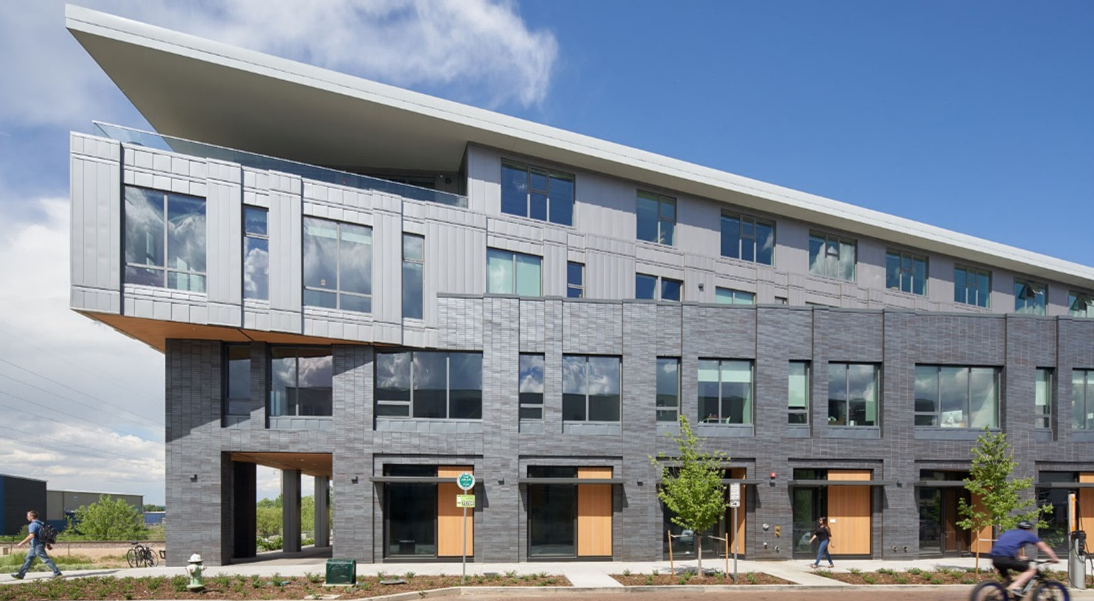
Boulder Commons
In Boulder Commons (Phase 1), a set of net-zero office buildings in Colorado, I will never forget the conversations around the high costs to use fiberglass clips to hold the additional continuous insulation to the building. While less conventional, someone on the team familiar with construction asked if offset wood 2x4, split in half to brace the continuous insulation boards would perform well enough to meet the insulation targets. While wood is not a great insulator, it is far better than metal if used the right way.
John Weale, Circa 2008
Optimizing Cooling and Heating with Energy Recovery
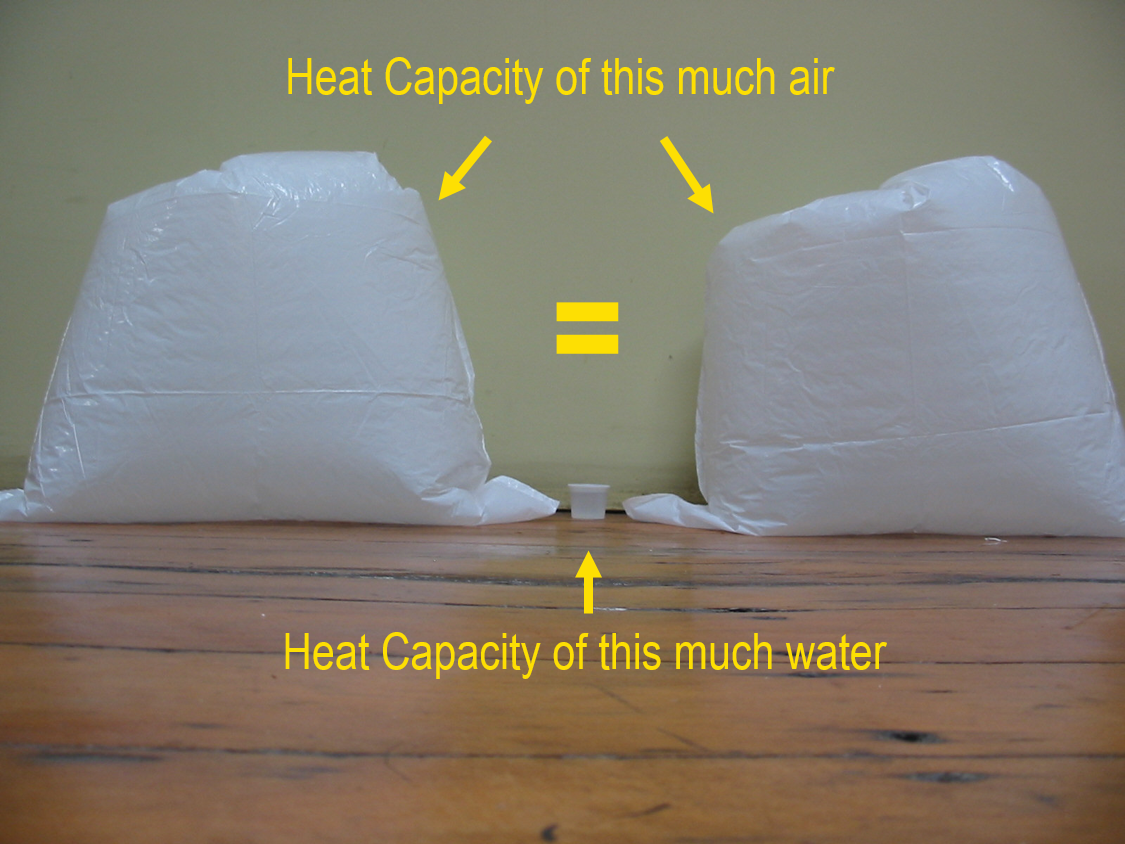
While moving heat through forced air seems like the standard, air is one of the least efficient ways of moving energy and one of the hardest to recover energy from. In a decarbonized building, recovering energy in a simple way is necessary. Small pipes moving water, often with zone fan coils, chilled beams or in-slab radiant heating and cooling, not only provides a great mechanism for heating and cooling, but it also keeps energy primarily in the water, enabling more ways to recover heat and move heat. These systems form the foundation and can be readily combined with heat recovery, thermal storage, and heat pumps. Traditional systems are mostly engineered for efficient cooling, leveraging airside economizing though losing any low-grade heat to the outside air. A decarbonized HVAC system focuses on heating and cooling and the balance of both, finding ways to shift heat with heat recovery heat pumps or thermal storage, and recovery heat with ventilation heat recovery.
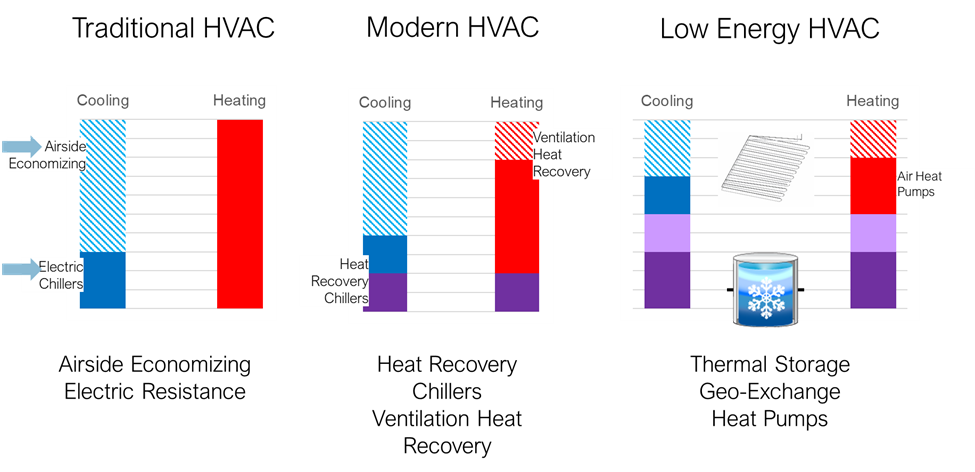
Decarbonizing a building’s HVAC requires focusing on ways the cooling and heating systems can work together to provide energy as efficiently as possible. Below is a rough estimate of the annual system efficiency to move heat for a large campus of office buildings where utilizing effective heat recovery systems and hydronic distribution were able to boost the efficiency by 3x.
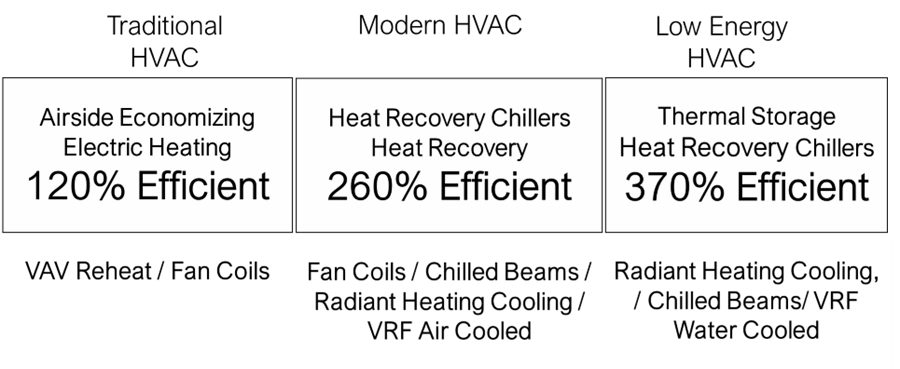
While there are many other facets to fully demystify what it means to decarbonize a building, these are two we work with daily. Although we greatly advocate for the capabilities of large heat pumps and emerging technologies, genuine solutions often arise from thoroughly examining a building's actual requirements and subsequently devising carefully planned procedures to integrate them effectively.