Mitigating Moisture Intrusion in Wood Buildings: Architectural Detailing to Avoid Decay in Mass Timber Structures
This presentation was given at the 2023 FPS International Conference on June 6, 2023. A2 Efficiency helped Method Studio examine how dew point is managed in three vulnerable building conditions in a typical mass timber structure.
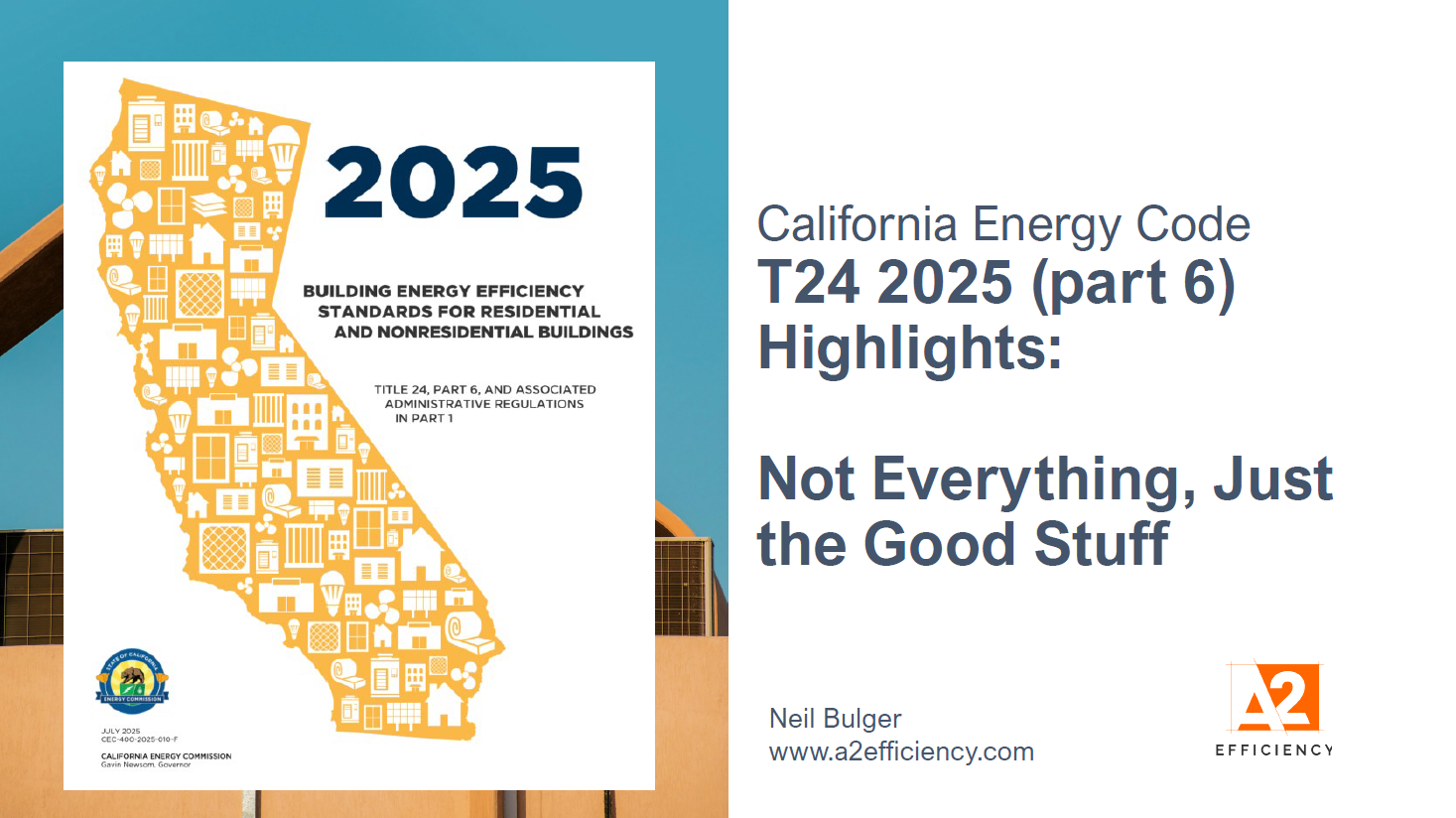
California Energy Code T24 2025 (part 6) Highlights: Not Everything, Just the Good Stuff
2026 is here and with it a new energy code in California. We wanted to highlight some of the things we thought were most intriguing and people should know about, specifically the less discussed yet amazing optional restructured code format, so easy to find things!
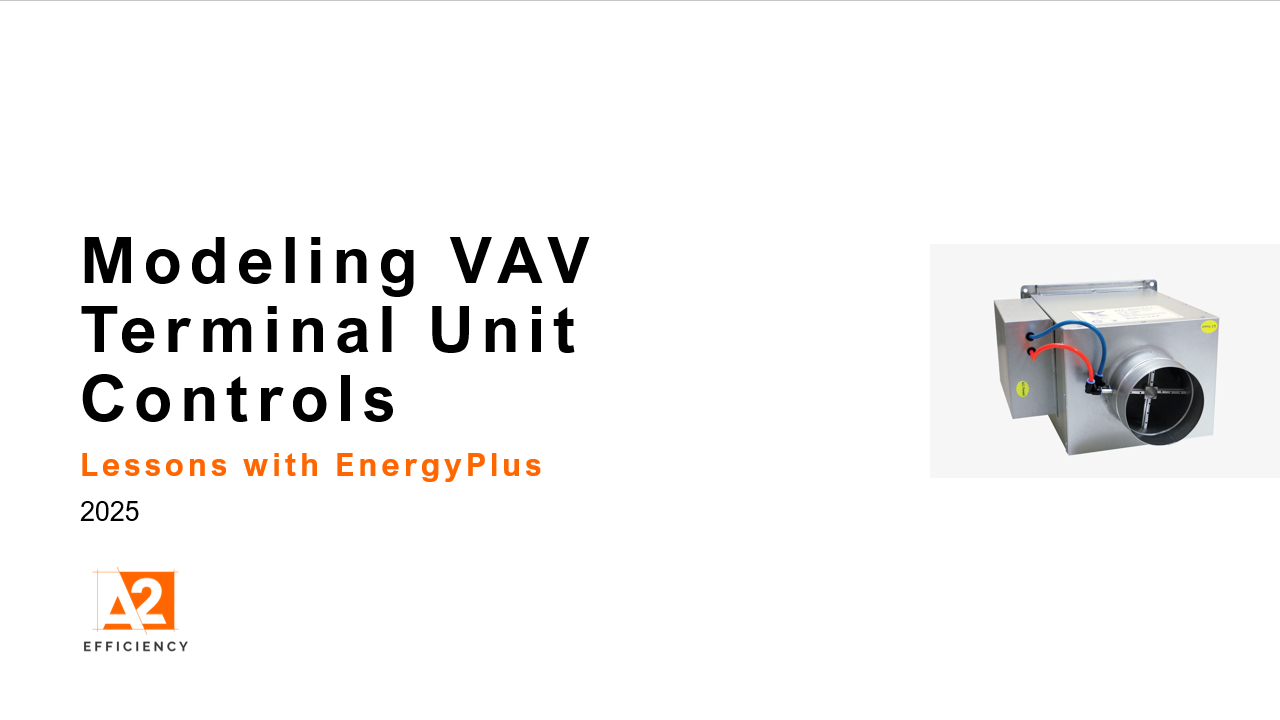
Modeling VAV Terminal Unit Controls: Lessons with EnergyPlus
In this EnergyPlus demo, we show how something as basic as minimum airflow during heating can be misrepresented in simulations—and how common this is with VAV systems which may be using Guideline 36 controls.
Designing for Resilience, Passive Survivability: Strategies in Mild and Hot Climates to Prevent Overheating
This presentation was delivered on October 7th as part of the I-REN virtual Fall 2025 C&S Forum: Resiliency in a Changing Energy Landscape. It explores key strategies for designing buildings that remain safe and habitable during extreme heat events and utility outages. Focusing on passive survivability and resilience in mild and hot climates, it outlines how thoughtful design can prevent overheating and maintain critical life-support conditions when mechanical systems fail.
Shared Energy and Land Use: Data Centers and Mixed-Use Development
This presentation was given at the 2025 Net Zero Conference on October 1st in Los Angeles. It investigates the growing overlap between high-demand data center development and mixed-use residential zoning. It examines how shared infrastructure and land-use strategies might enable data centers and housing to co-exist, leveraging collaboration between energy, heat-reuse and urban planning.

Seeking Energy Model Accuracy: Building on Code Compliance Modeling
A2 Efficiency shared insights on balancing compliance, precision, and real-world building performance to advance net-zero goals during the CalBEM Spring Working Group cross-pollination meeting.

Getting to Zero: Faster - Land Use Solutions for Mixed Use Development and Heat Sharing
A2 Efficiency led a workshop during the Getting to Zero Forum on April 24, 2025, exploring strategies for integrating data centers and central campus HVAC systems into sustainable, efficient mixed-use projects.
Designing for Resilience, Passive Survivability: Strategies in Mild and Hot Climates to prevent overheating
This presentation was delivered at the CABEC 2024 Conference on September 24, 2024. It focused on resilient design strategies to manage overheating in buildings, especially in mild and hot climates, by applying the concept of passive survivability to maintain health and safety during extreme heat events and utility disruptions.
Demystifying VRF and How to Estimate Performance with OpenStudio
This presentation was given at the 4th Building Simulation User Group (BSUG) at the University of Idaho’s Integrated Design Lab on September 4, 2024. It sheds light on VRF systems and demonstrates how to estimate their performance using OpenStudio.
Revolutionizing Decarbonization: Monobloc Heat-Pump Solution for Existing Homes
This presentation was delivered at the ACEEE 2024 Hot Water & Hot Air Forum on March 13, 2024 as part of the Retrofit-Friendly Airt-to-Water Combination Heat Pump Systems panel. It reported on the evaluation of a combined air-to-water heat pump (Combi-HP) system that provides space heating, cooling, and domestic hot water in an existing home, offering insight into performance, efficiency, and real-world application of high-efficiency electrified HVAC solutions.

Maximizing Heat Recovery in DOAS: Best Practices for Energy Modeling of High-Efficiency Systems
This presentation was delivered at the ACEEE 2024 Hot Water & Hot Air Forum on March 12, 2024 as part of the Innovation Beyond Heat Pumps and Efficiency panel. It focused on best practices for energy modeling of High-Efficiency Dedicated Outdoor Air Systems (HE DOAS), with an emphasis on maximizing heat recovery and evaluating Very High Efficiency (VHE) approaches to DOAS in commercial buildings.