Healthy, Resilient California Schools with a Fraction of the AC
Good Architecture Is the First Mechanical System
How integrated design can modernize school HVAC from the ground up
California's schools are under pressure from every direction at once.
Wildfire seasons that once felt like an anomaly are now a fact of life, forcing districts to think seriously about indoor air quality in buildings that were never designed for filtered ventilation. Energy and maintenance costs keep rising, straining operating budgets that were already thin. And for districts investing in new buildings or major renovations, project budgets are being squeezed by rising construction costs and growing system complexity, making every dollar of first cost a decision that matters.
In the world of school HVAC design, we are seeing more and more projects in coastal California, historically some of the most temperate building climates in the country, where the question is now simply: should we be fully air conditioned? Peak heat events are arriving earlier in spring and stretching deeper into fall. Heat stress and resilience have become foundational concerns in our work, things we have to address before we even get to the question of thermal comfort.
What if schools could be built better, resilient to a changing climate, and simpler, using integrated design to match the mechanical system to the task at hand?
Where This Idea Came From
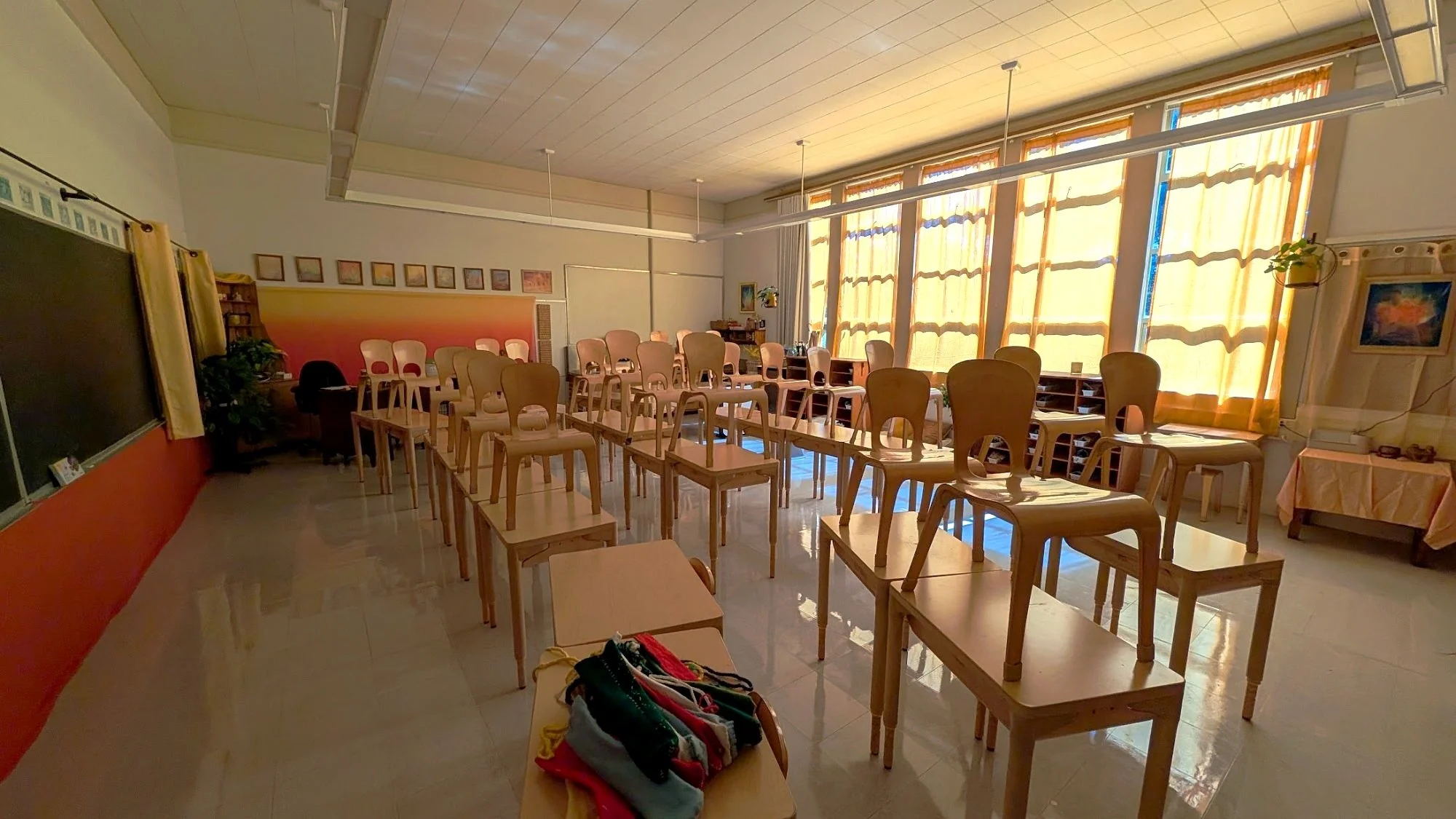
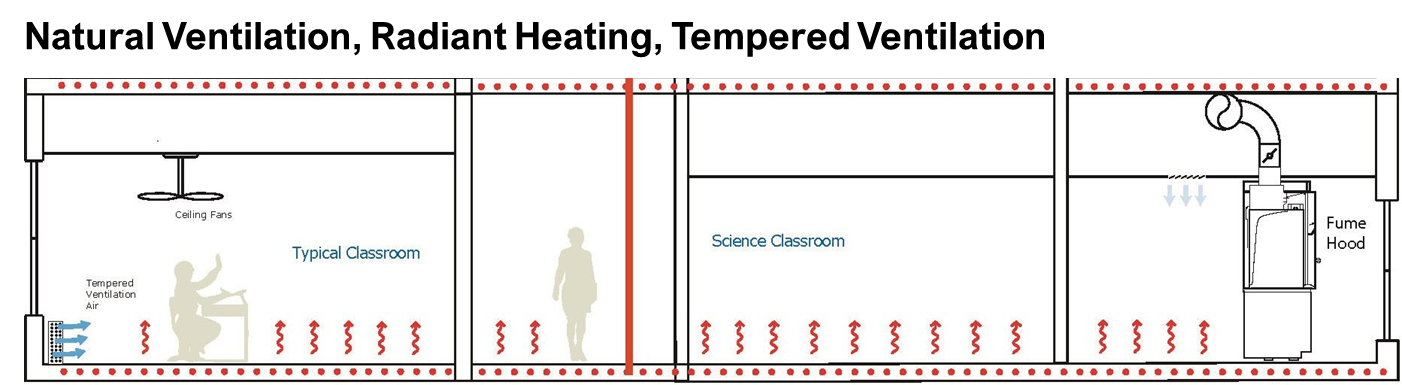
The seeds of this approach were planted at a school campus on the lower San Francisco peninsula, where we helped design a campus built almost entirely around heating and natural ventilation, no air conditioning. The strategy was grounded in California's coastal climate: diurnal temperature swings are reliable, thermal mass is your friend, and good architecture can do the heavy lifting that mechanical systems typically get paid to do.
It worked. For years it worked beautifully.
Then climate change began reshuffling the deck. Peak heat events became more frequent, less predictable, harder to absorb with mass and night flush alone. In one of the campus's newer buildings, a library originally fully passively cooled in Hillsborough, teachers came back after a hot summer and said, simply: we need air conditioning. And they weren't wrong. The climate data below shows the changes and peak events the site experienced, with temperatures hitting 93°F in 2014 and then 102°F in 2020 with a design condition of 83°F.
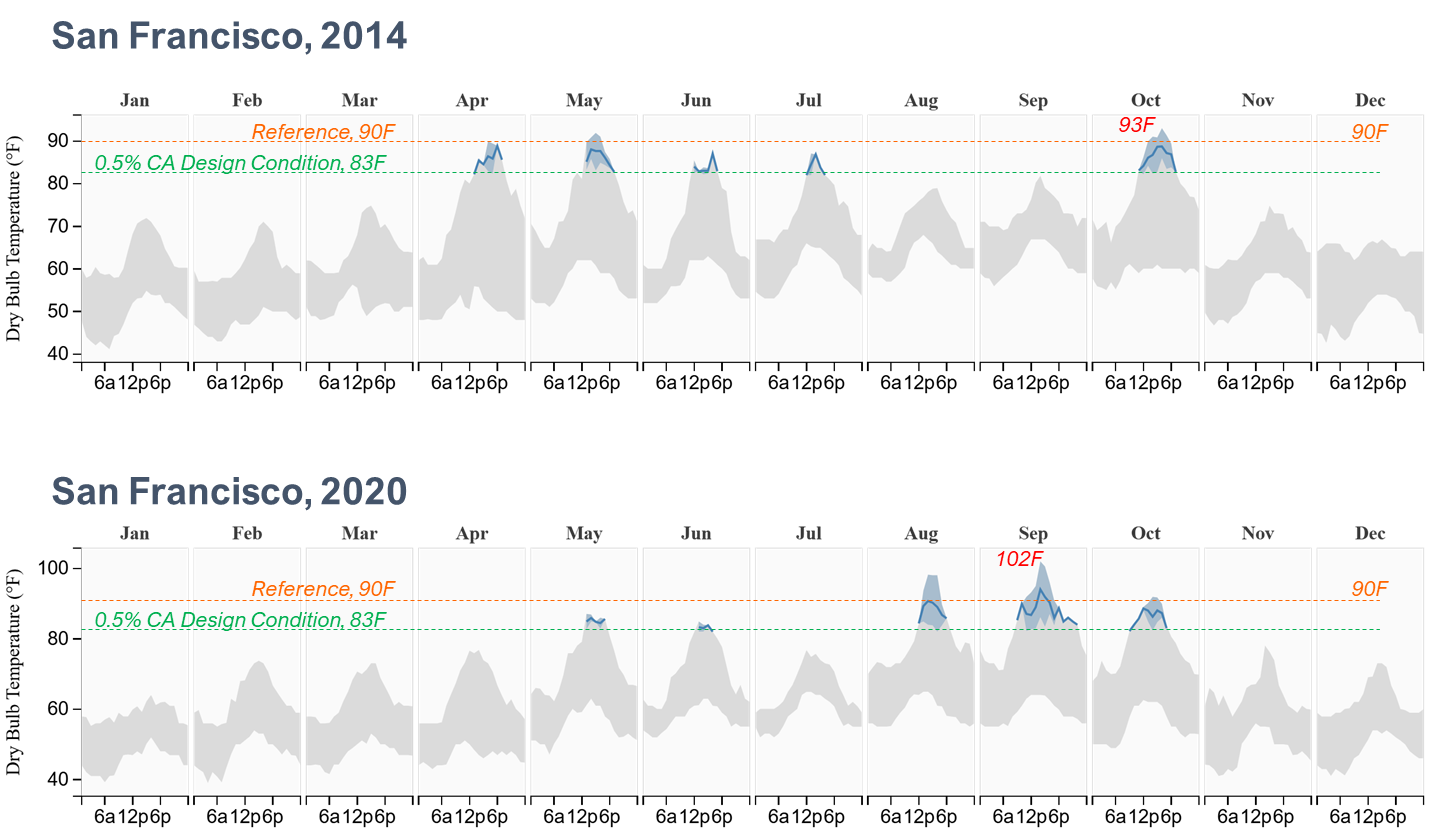
This was not a failure of passive design. It was a signal. Fully passive buildings carry real risk in a changing climate, and the design community needs to be honest about that. At the same time, the answer is not to abandon everything that makes passive design powerful and install full air conditioning everywhere. The answer is to find the smallest, simplest system that preserves all the benefits of passive design and adds just enough mechanical capacity to manage the risk.
The Two Hard Limits, and Why They’re a Gift
Every school building, every building, has two non-negotiable mechanical requirements: ventilation and heating. You have to bring in fresh air. You have to keep people warm. Everything else is a choice. Even air conditioning!
In California today, wildfire smoke means fresh air almost always needs to be filtered and delivered mechanically. That means ducts. That means a fan. That means airflow to every classroom. Here is what linear thinkers, and engineers are the proudest linear thinkers, can do with hard limits: they can reverse the question.
Instead of asking "How much air conditioning do we need to be comfortable?" we ask: "If the only cooling we have is what comes with our ventilation system, how does the architecture need to perform to make that enough?"
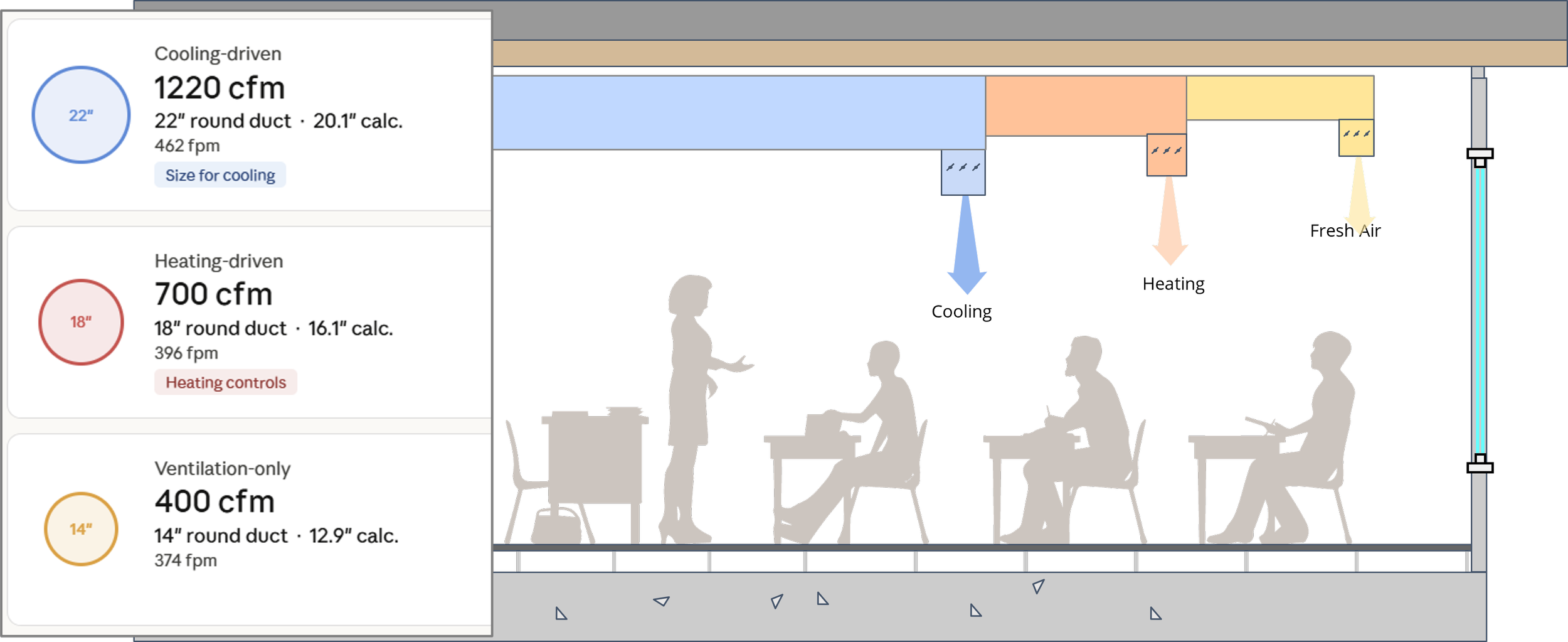
Three duct sizes. Three different design decisions. The gap between cooling-driven and ventilation-only is 8 inches of duct diameter, and everything this idea is about.
This reframing is not a design constraint. It is a design generator. Aim for the ventilation limit, the smallest system possible, and architecture has a clear, measurable target to work toward.
Architecture as the First Mechanical System
When you establish that your system capacity is defined by ventilation, not by peak cooling load, you hand architecture a mandate. Solar shading has to work. Thermal mass has to work. Orientation matters. Window-to-wall ratio matters. Cross ventilation and night flush matter. Passive design stops being a nice-to-have and becomes a load-bearing part of the mechanical system.
For engineers, this target is also an invitation to sharpen assumptions. Are we assuming adult body heat or kids'? Will lights really be at full power at 3pm in July? Can air movement let us raise the setpoint by 3 degrees? These moves are essentially free, the benefit of taking the time to work the problem rather than stamp a default.
The Comfort Conversation We're Not Having
Here is an uncomfortable truth engineers know but rarely say out loud: air conditioning does not guarantee comfort. At its best, the modern comfort standard satisfies about 80% of occupants at any given time, because one person wears a sweater and one person wears shorts, and no system can make both perfectly comfortable simultaneously.
The industry's primary comfort standard, ASHRAE 55, a technical guideline that defines what "comfortable" actually means in a building, gives engineers substantial latitude here. Comfort is not just about air temperature. It accounts for clothing level, air movement, and even the outdoor temperature people just walked in from. When it's warm outside, people tolerate warmer conditions inside. That flexibility is an invitation: instead of defaulting to 75°F and calling it done, engineers can design to 78°F with good air movement and achieve the same, or better, occupant satisfaction with a fraction of the cooling load.
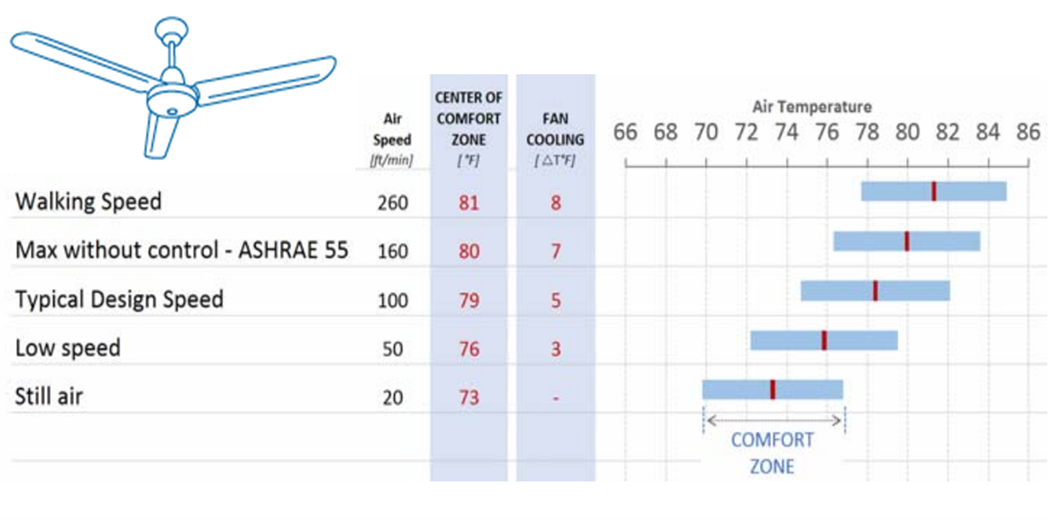
This reframes the conversation with owners entirely. The question is not "do we have air conditioning, yes or no?" The question is: what level of thermal comfort are we committing to, under what conditions, and at what probability of success?
When owners understand that framing, they often accept smaller, simpler systems willingly, because the promise was never "perfect comfort for everyone." It never was.
The Upstream Dividend
The smallest system is not just about cost or simplicity, though it delivers both. Every control point you don't install is a control point that never fails, never needs commissioning, never needs a service call. Every shaft you don't cut is a shaft that doesn't compromise structure, doesn't lose ceiling height, doesn't create coordination conflicts between trades.
This is the upstream dividend of integrated design. If the design team is not thinking this way, if passive design and mechanical design are happening in parallel instead of in sequence, you will always overbuild. You will buy controls you don't need, duct space you won't use, and capacity that serves as insurance for the engineer's liability rather than value for the school district's students.
The control point you didn't buy is the control point that never failed, never needed commissioning, and never generated a service call.
Integrated design, done well, is not just a process. It is a resource multiplier. Every dollar saved on mechanical systems is a dollar available for the building envelope, the classroom acoustics, the courtyard, the things that shape the experience of learning.
A Final Word
The numbers behind this piece are illustrative, not absolute. Every school is different, every climate is different, and every budget conversation is different. What these scenarios are meant to show is not a single right answer but a way of thinking, one that starts with the smallest system and works backward to what the architecture needs to do to make that possible.
The teachers at the Hillsborough library were right to ask for air conditioning. The lesson isn't that passive design failed. It's that the margin was too thin, and no one had left room for it to be anything other than perfect. The integrated approach described here doesn't ask architecture to be perfect. It asks it to be deliberate. To do its job first, so the mechanical system can do less.
That conversation, between architect and engineer, early, before the load calculations are even run, is where this all starts. The duct size is a downstream consequence of decisions made months earlier about shading, mass, orientation, and setpoints. If those conversations happen, the duct gets smaller. The unit gets smaller. The screen gets shorter. The roof gets cleaner.
And the school gets better, not despite spending less on mechanical systems, but because of it.
Want the numbers? We ran this analysis across six design packages, calculating cooling loads, heating loads, RTU sizing, duct sizes, first costs, physical footprint, and a full benefits scorecard. Download the full technical analysis below.