Combi Heat Pump Field Assessment
Client: Coffman Engineers
Program: Manufacturer Field Assessment
Building Use: Single-Family Residential
Location: Northern California (Address Confidential)
Year Completed: 2025
Building Size: 1,750 sf
Goals: Field Efficiency Assessment, U.S. Market Readiness, Electrification, Technology Research
Tools: Third-Party Sub-Metering
Category: Technology Research Electrification
Project Overview
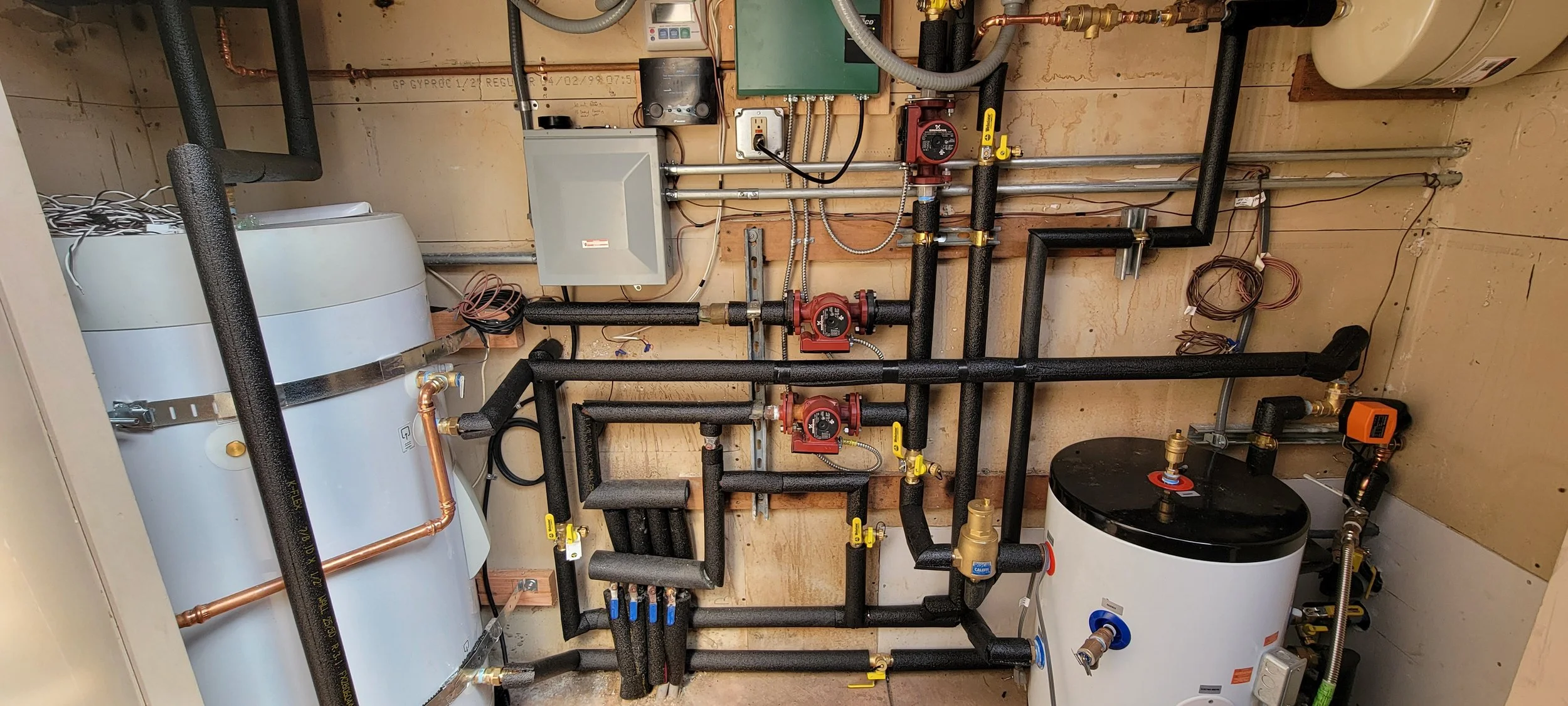
A manufacturer engaged A2 Efficiency to conduct a 12-month field evaluation of a European-manufactured monobloc combi heat pump at a single-family residential site in Northern California. The system simultaneously provides space heating, space cooling, and domestic hot water (DHW), replacing two existing natural gas boilers. The manufacturer sought to assess real-world energy efficiency, identify installation and controls challenges, and inform U.S. market adoption strategy for the product.
The evaluation ran from April 2024 through March 2025, spanning full heating and cooling seasons in a mild marine climate with in-floor radiant hydronic distribution.
Our Role
Led project management, site recruitment, system engineering, and instrumentation design for the 12-month field demonstration.
Specified and installed third-party monitoring equipment to capture compressor power, DHW flow and temperature, and primary loop conditions independent of manufacturer data logging tools.
Developed and applied COP calculation methodology for three discrete operating modes: space heating, space cooling, and DHW, aligned with the NEEA Advanced Water Heating Specification.
Coordinated with manufacturer technical staff, a local HVAC installer, and specialist subcontractors (Ecotope, Stober Engineering) throughout installation, commissioning, and monitoring phases.
Delivered final assessment report documenting operational findings, bill analysis, installation lessons learned, and market readiness recommendations.
Project Highlights
Estimated 21% annual energy cost savings (~$205/year) versus the replaced gas boiler system; optimization of controls could push savings to 41%.