San Francisco NZE Office Assessment
Owner: Confidential
Building Use: Commercial Office
Location: San Francisco, CA
Year Completed: 2025
Building Size: Confidential
Goals: NZE, Tenant Transition Ongoing Energy Monitoring
Category: Commercial Retrofit, New Construction, Utility Incentive Support
Key Stats:
EUI: 20-22 kBtu/sf-yr
5 remediation measures
Project Overview
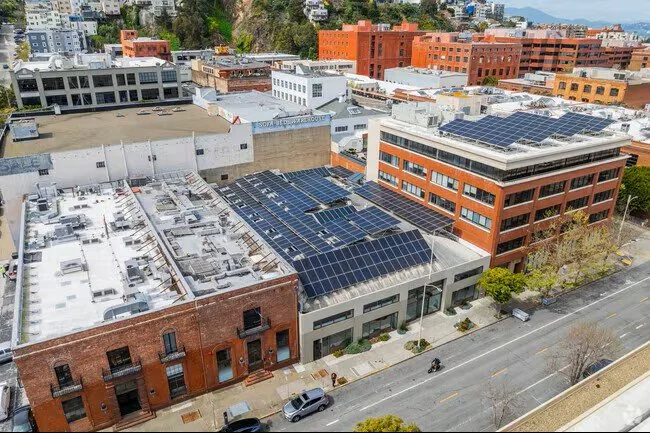
A San Francisco commercial office building with an on-site solar PV system had achieved Net Zero Energy (NZE) status under its prior tenant. With the arrival of a new tenant operating an innovation center with higher and less predictable energy loads, the building owner engaged A2 Efficiency to assess the NZE risk for the 2025 calendar year and identify a prioritized set of remediation measures.
The assessment drew on historical metered energy data from the Lucid monitoring system (2018–2023), solar PV production records, and interviews with the incoming tenant to estimate new consumption patterns. The building features a high-performance envelope including LED lighting, VRF heat pumps, and energy recovery ventilators, with a measured EUI of 20–22 kBtu/sf-yr, well below the 30–40 kBtu/sf-yr typical for comparable office buildings.
Our Role
Reviewed and synthesized historical Lucid metering data across multiple end-use circuits: HVAC, ERVs, lighting, plug loads, and IT, to establish a prior-tenant energy baseline.
Estimated new tenant annual energy consumption for average and above-average scenarios based on occupancy interviews and innovation center equipment descriptions.
Assessed NZE risk across four energy scenarios by comparing estimated consumption against modeled solar PV production
Developed a five-measure remediation plan with an implementation timeline mapped to quarterly milestones for the 2025 calendar year.
Project Highlights
Under average new-tenant conditions, NZE status is achievable with a modest surplus.
Five remediation measures identified, ranging from near-zero-cost scheduling and monitoring (Measures #1–2) to HVAC zone lockout and a potential PV expansion (Measures #3–4).